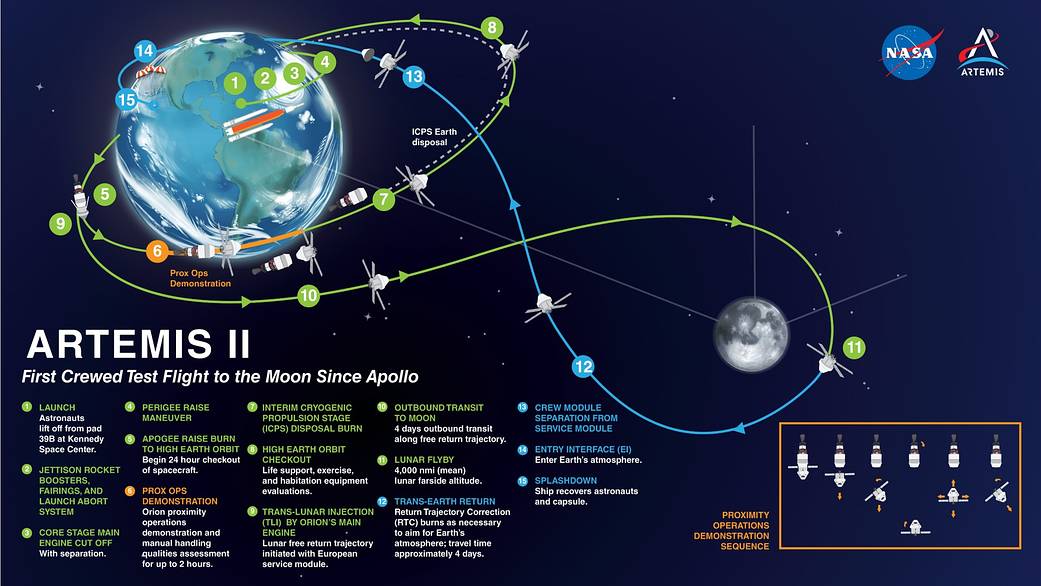
The four-person crew of the Artemis II mission—Reid Wiseman, Victor Glover, Christina Koch, and Jeremy Hansen—is currently conducting a historic flyby of the Moon. Following their launch from the Kennedy Space Center on April 1, the astronauts have surpassed the distance record previously held by the Apollo 13 mission, reaching over 40,000 kilometers from Earth.
NASA has opened the mission to unprecedented public scrutiny, offering both high-level telemetry and mass-market broadcasting. Viewers can track the Orion capsule’s trajectory, velocity, and distance via the agency’s Artemis Real-time Orbit Website (AROW). This platform provides the same data utilized by Houston engineers, including the capsule's orientation and active camera feeds.
For those seeking a deeper technical dive, the Deep Space Network (DSN) Now tool displays real-time connections between the Orion capsule and ground stations in Madrid, Goldstone, and Canberra. NASA’s 2026 app also provides push notifications for critical events, such as engine burns or signal loss.
Global broadcast and mission timeline
Beyond technical tracking, NASA has partnered with major streaming platforms to broadcast the mission. In Mexico and elsewhere, the flyby is available on YouTube, Netflix, and HBO Max. While YouTube offers a 4K resolution feed for minute-by-minute tracking, the other platforms have dedicated channels to the event.
According to the mission schedule, the flyby began at 14:45 EST. The closest approach to the lunar surface is set for 19:02 EST, with a maximum distance from Earth occurring five minutes later. A notable window of silence is expected at 18:44 EST, when the capsule loses communication for 40 minutes while passing behind the Moon.
Despite the proximity to the lunar surface, the crew will not land. The mission utilizes a free-return trajectory that leverages lunar gravity to swing the craft back toward Earth. The mission's peak velocity is approximately 40,000 km/h, required to overcome terrestrial gravity. The point of periluna—the minimum distance to the lunar surface—is calculated at roughly 10,300 kilometers.
This flight serves as a precursor to future lunar exploration. Artemis III, scheduled for 2027, will focus on testing docking capabilities with commercial landers in low Earth orbit. A human landing on the lunar surface is not expected until the launch of Artemis IV in 2028, which aims to install the first international lunar module at the Moon's south pole.
As the mission progresses, Fayerwayer notes that the sudden increases in velocity are not errors, but the result of lunar gravity taking control. "If you see that the speed increases suddenly, it is not a web error: it is the Moon's gravity taking control," the outlet reported. "Today, more than ever, we are all part of the crew. Have a good trip, Orion!"