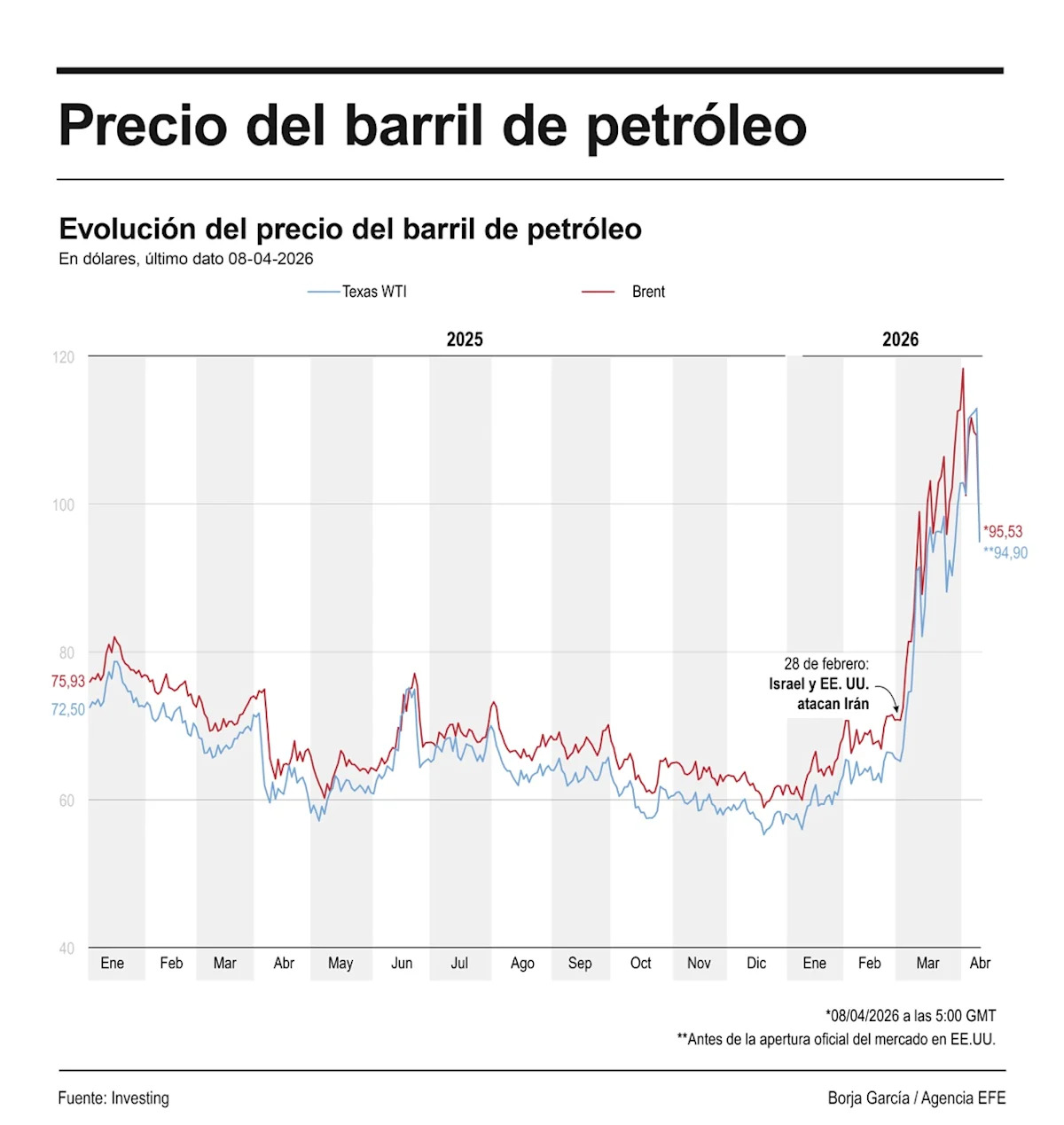
Oil prices surged on Thursday after Iran accused the United States of violating the terms of a two-week ceasefire, pushing benchmarks closer to the $100 per barrel mark.
Brent crude futures for June delivery rose 3.4% to $98.03 per barrel in London. U.S. West Texas Intermediate (WTI) jumped 3.6% to $98.03 per barrel, rebounding from its largest single-day drop since 2020.
Iranian Parliament Speaker Mohammad Bagher Ghalibaf stated Wednesday that Washington failed to uphold key components of the truce. Ghalibaf cited ongoing Israeli attacks in Lebanon, a drone intrusion into Iranian airspace, and the denial of Tehran's right to enrich uranium as primary breaches.
“The profound historical distrust we have toward the United States comes from its repeated violations of all types of commitments, a pattern that unfortunately has repeated once more,” Ghalibaf said in a social media statement.
Diplomatic tension and market volatility
U.S. Vice President JD Vance pushed back against the accusations during a visit to Hungary on Wednesday. Vance described ceasefires as inherently complex and maintained the U.S. position against Iranian uranium enrichment.
Vance also clarified that any potential ceasefire involving Lebanon was not part of the current agreement. This disagreement follows President Donald Trump's recent indication that the Iranian proposal could serve as a basis for future negotiations.
Market analysts warn that even if peace is achieved, energy supplies may not stabilize immediately. Reestablishing full traffic through the Strait of Hormuz could take weeks as maritime insurance coverage takes time to reactivate.
“The initial euphoria dissipates quickly: Israel continues operations in Lebanon, traffic through the strait has not normalized with the expected speed, and analysts warn that two weeks is an insufficient timeframe to resolve a conflict of this magnitude,” said Liza Salinas, Branch Business Director at Liberty Finance.
Janiv Shah, Vice President of Commodities at Rystad Energy, suggested refineries should use the current price levels to resume opportunistic buying. However, he warned that if refineries delay purchases expecting further price drops, product shortages could intensify despite a potential de-escalation.
Goldman Sachs has already lowered its second-quarter projections, forecasting Brent at $90 and WTI at $87 as the wartime premium is expected to ease if negotiations progress.