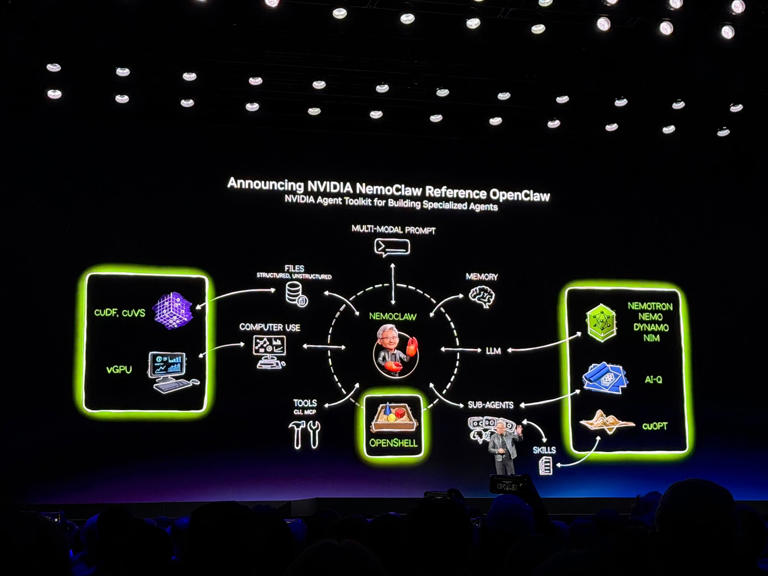
NVIDIA unveiled NemoClaw on March 16, 2026, as a new security layer to strengthen OpenClaw, an open platform for multi-agent AI orchestration. The new tool aims to provide stricter privacy and security controls for executing multi-agent systems.
NVIDIA defines agentic AI as a system of specialized agents that collaborate toward a common goal. Unlike standard Large Language Models (LLMs) that primarily predict text sequences, these agents possess memory, tools, and the ability to plan and act within the physical and digital world.
The rise of the digital workforce
Corporate adoption of autonomous agents is accelerating. Microsoft reported in February 2026 that over 80% of Fortune 500 companies are already utilizing active agents. Furthermore, 82% of leaders surveyed in Microsoft's 2025 Work Trend Index expect to deploy 'digital labor' to expand their workforces within the next 18 months.
Financial projections suggest a massive shift in corporate productivity. McKinsey estimates AI could unlock $4.4 trillion in productivity for corporate use cases. While 92% of companies plan to increase AI investment, only 1% currently consider their deployment mature.
NVIDIA CEO Jensen Huang is positioning the company's infrastructure to support this transition. The company's roadmap moves from perception and generative AI toward agentic AI, physical AI, and eventually general robotics. To support this, NVIDIA is developing 'AI factories' and tools like the NeMo Agent Toolkit and NemoClaw.
New hardware architectures, such as NVIDIA's Vera, are being designed to handle massive scales. The architecture can support more than 22,500 concurrent environments per rack, allowing for tens of thousands of agentic instances.
This shift is creating a new professional role described by Microsoft as the 'agent boss.' This individual focuses on building, delegating, and supervising agents rather than performing manual tasks. Experts suggest the human role will evolve into 'creative metacontrol,' where humans define objectives and judge the qualitative sense of AI outputs.
Industry analysts at BCG note that agents already account for 17% of the total value generated by AI in 2025, a figure projected to reach 29% by 2028. However, Deloitte warns that only one in five companies currently possesses the necessary governance maturity to manage autonomous agents.