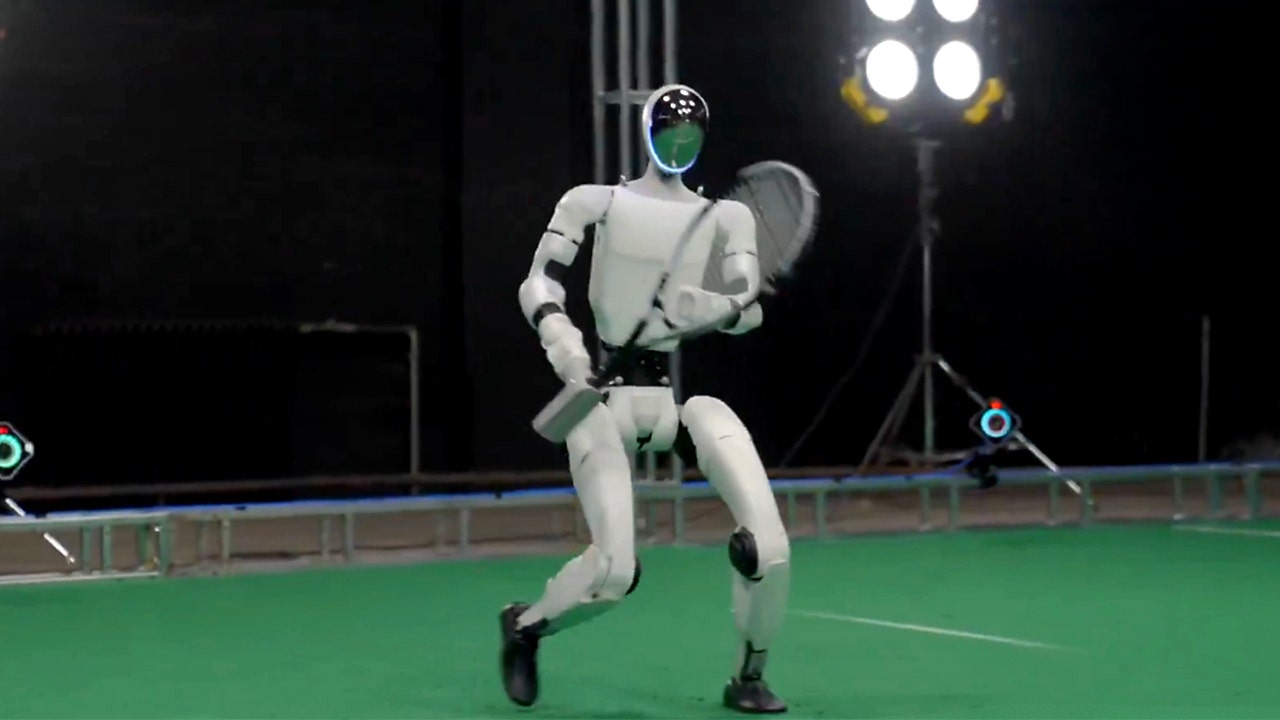
A Chinese humanoid robot has mastered the fundamentals of tennis in just five hours of training, according to a new research paper titled LATENT. Developed with support from the robotics firm Galbot, the project uses reinforcement learning to bridge the gap between virtual simulation and physical movement.
The breakthrough has captured the attention of the global tech community. Elon Musk reacted to the footage on X, while AI researcher Andrej Karpathy noted he initially believed the video was AI-generated rather than a recording of a physical robot.
Simulation to reality
The robot's rapid skill acquisition relies on high-fidelity virtual environments. Before ever touching a physical racket, the machine played millions of matches in a digital simulation, testing every possible angle of impact and lateral movement.
This massive pre-training allows the hardware to execute complex tasks immediately upon entering the real world. The robot demonstrates precise eye-hand coordination by processing ball trajectories in milliseconds. It also maintains dynamic balance, allowing for sudden stops and lateral shifts without falling.
The LATENT project, which stands for Learning Athletic Humanoid Tennis Skills from Imperfect Human Motion Data, was recently published as a preprint on arXiv. The researchers demonstrated that the robot can adjust its striking force and angle based on the opponent's real-time position.
While the technology currently resides in Chinese laboratories, its potential reach extends to sports training centers in Latin America. The ability to replicate professional playing styles could eventually provide high-performance training partners for athletes in countries like Argentina, Chile, and Mexico.