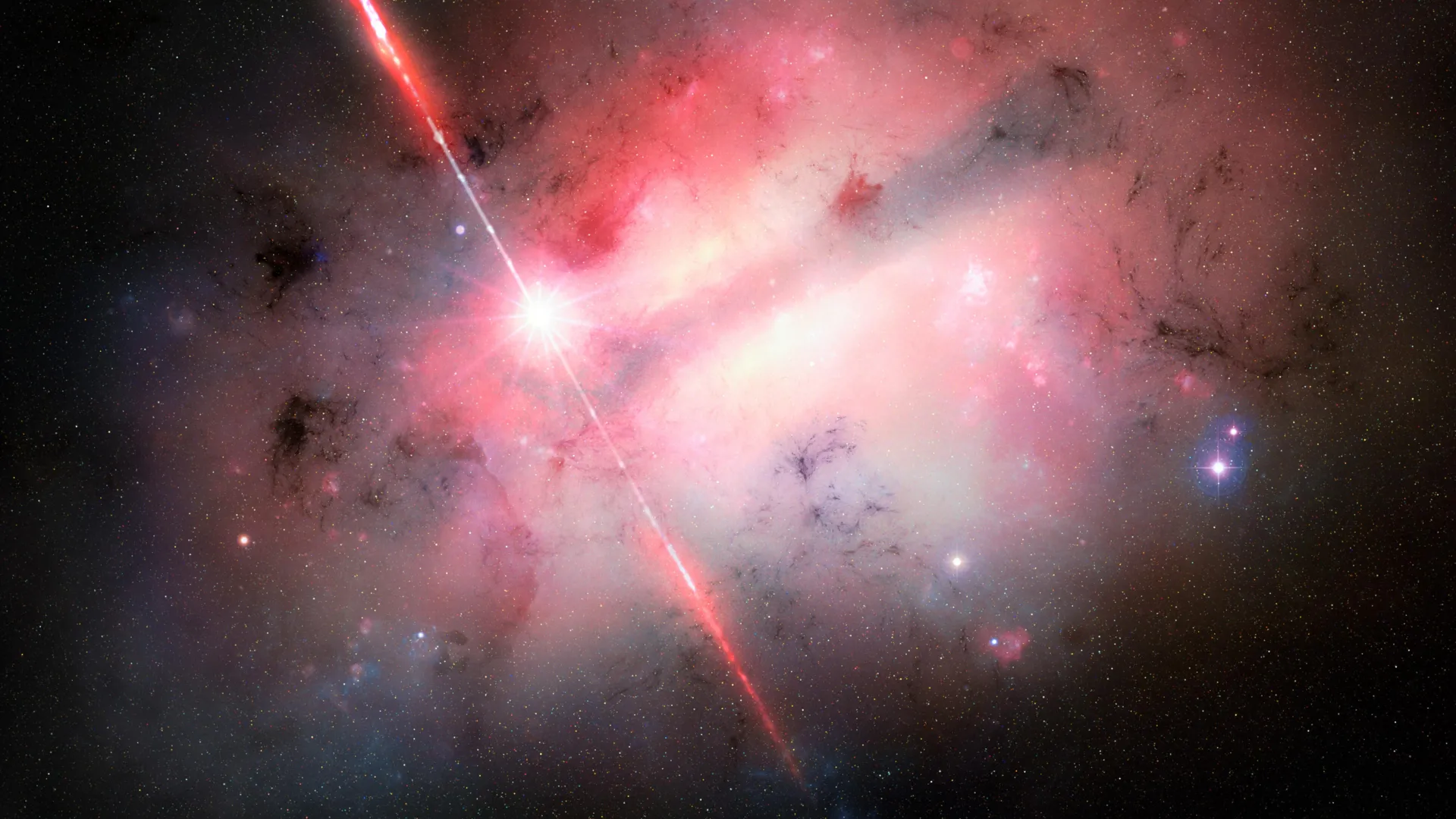
A new study led by Yongda Zhu at the University of Arizona indicates supermassive black holes can silence star formation across millions of light-years. Published in The Astrophysical Journal Letters, the findings suggest galaxy evolution functions as an interconnected ecosystem rather than isolated units. This research challenges traditional models where distant galaxies evolve independently of one another.
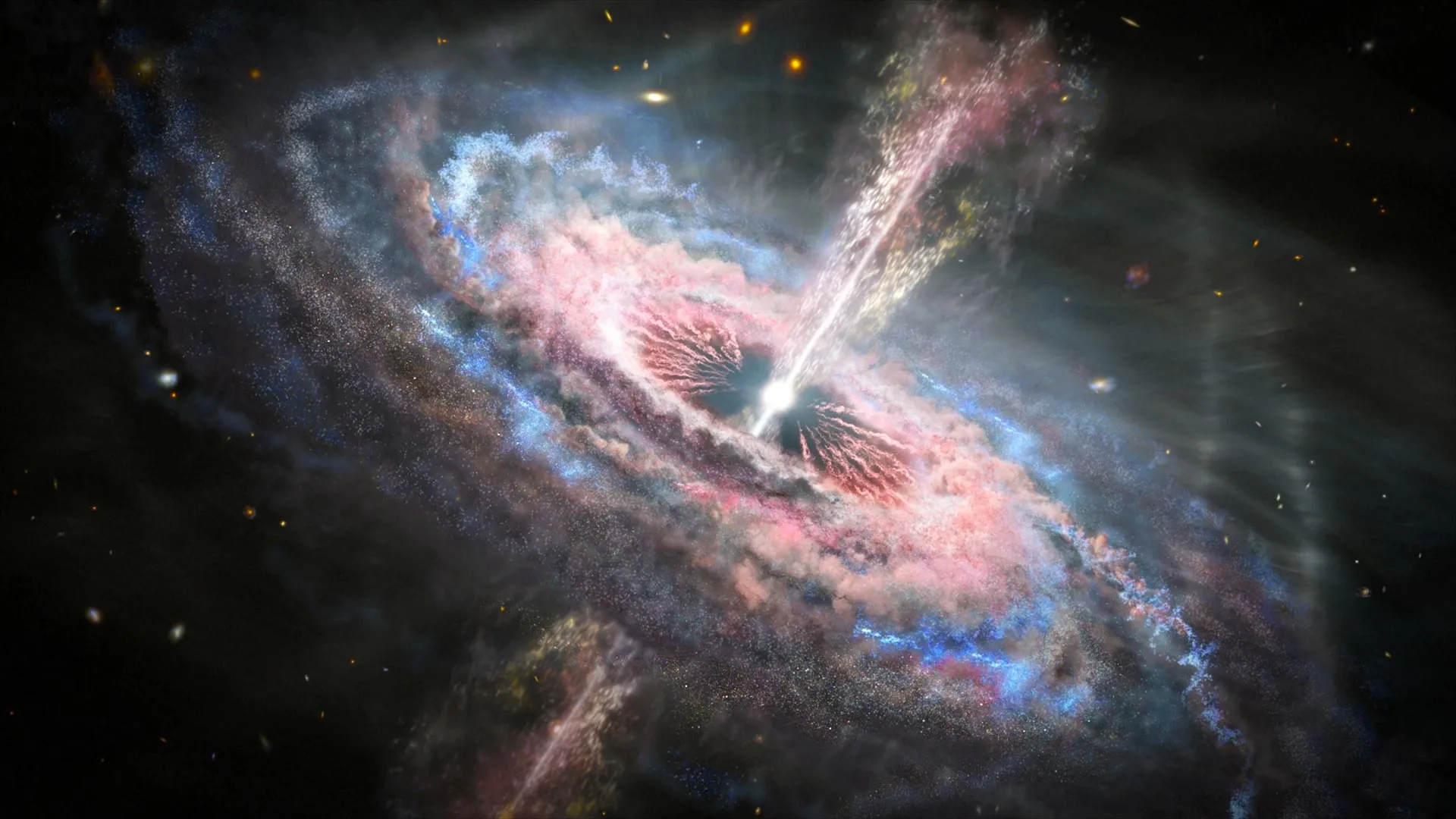
The team analyzed data regarding the quasar J0100+2802, a massive object with a black hole weighing 12 billion times the mass of the sun. Astronomers used the James Webb Space Telescope to measure oxygen emissions that signal recent star formation activity in surrounding regions. They discovered that galaxies within one million light-years showed significantly weaker signals compared to their ultraviolet light output.
Key Findings
Zhu described the phenomenon as a hungry predator dominating the local cosmic environment. The intense heat and radiation from the active black hole split the molecular hydrogen necessary for creating new stars. This process effectively quenches the potential for gas clouds to accumulate and ignite into stellar objects.
Initial data from the space telescope revealed fewer galaxies than anticipated around some of the brightest quasars in the early universe. Researchers initially questioned if the expensive instrument was malfunctioning before realizing star formation had been suppressed in those areas. This insight led to the conclusion that radiation from quasars limits growth in neighboring galaxies as well as their own.
Scientists already understood that quasars can destroy gas within their host galaxies, but the extent of this effect remained uncertain. By observing an object from the early universe, the team confirmed this influence reaches an intergalactic scale for the first time. The findings indicate radiation impacts the universe significantly beyond the immediate vicinity of the black hole.
Future Implications
The Milky Way likely experienced a quasar phase in its distant past, which may have influenced its development and that of its neighbors. Researchers plan to study additional quasars to determine if this phenomenon is widespread across the cosmos. They also aim to understand the mechanisms behind these interactions and whether other factors play a role.
Zhu stated that understanding how galaxies influenced one another in the early universe helps clarify how our own galaxy came to be today. Now scientists realize supermassive black holes played a much larger role in galaxy evolution than previously thought. This discovery opens a new window into how galaxies formed and evolved over billions of years.
The research team credited the James Webb Space Telescope with making the observation possible due to its advanced sensitivity. Earlier telescopes could not detect the faint infrared light stretched by the expansion of the universe. This technology allows astronomers to observe early cosmic events with unprecedented detail.