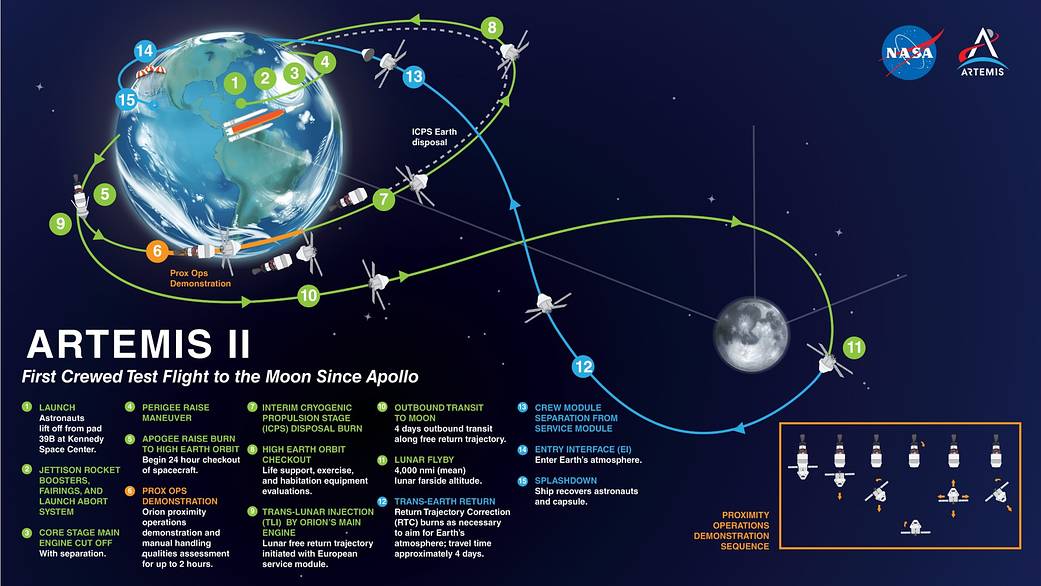
A crew of four astronauts launched aboard the NASA Artemis II mission, beginning a 10-day journey around the Moon. The mission marks the first time humans have traveled toward the lunar surface since the conclusion of the Apollo program more than 50 years ago.
The crew includes NASA astronauts Reid Wiseman, Victor Glover, and Christina Koch, alongside Canadian Space Agency astronaut Jeremy Hansen. While the mission does not include a lunar landing, the team will complete a full orbit of the satellite, testing systems for future long-term exploration.
A diverse crew for a new era
This mission represents a shift from the Apollo era by including the first woman, the first person of color, and the first non-American to participate in a deep-space lunar flight. Commander Reid Wiseman, 50, leads the crew, bringing experience from his 165-day mission on the International Space Station.
Wiseman spoke openly about the risks of the flight, noting that he prepared his two teenage daughters for the possibility of tragedy. "I told them, 'Here is the will, here are the documents,'" Wiseman said. "If something happens to me, this is what will happen to you. It is part of this life."
Victor Glover, 49, serves as the pilot of the Orion spacecraft. As the first Black astronaut to fly to the Moon, he credits his career to the path cleared by pioneers like Guion Bluford. Christina Koch, 47, holds the record for the longest spaceflight by a woman at 328 days and will be the first woman to reach the Moon’s vicinity. Canadian Jeremy Hansen, 50, rounds out the crew as the first international astronaut to participate in such a mission.
Preparation for the launch faced several delays throughout the year. NASA engineers were forced to return the Space Launch System (SLS) rocket to its hangar following technical assessments discovered during the winter. These repairs were necessary to ensure the integrity of the vehicle before clearing the crew for flight.
Following the completion of these reviews, NASA officials expressed confidence in the mission’s readiness. "The vehicle is ready, the system is ready, the crew is ready," said Amit Kshatriya, NASA’s associate administrator for the Moon to Mars Program.