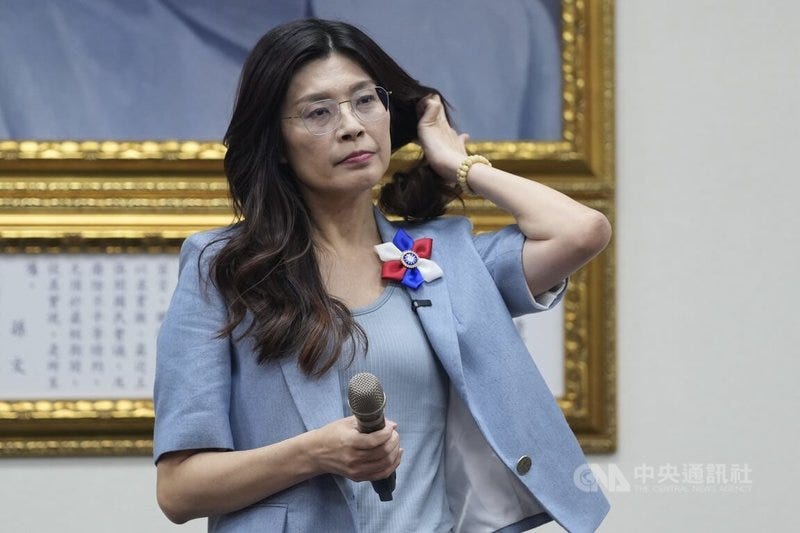
Kuomintang (KMT) Chairwoman Cheng Li-wun traveled to China this week to advocate for renewed dialogue between Taipei and Beijing. The visit marks the first time a KMT leader has traveled to the mainland in ten years.
Cheng began her trip Wednesday by laying a wreath at the mausoleum of Sun Yat-sen in Nanjing. The site holds historical significance as the former capital of the Republic of China prior to the KMT’s 1949 retreat to Taiwan.
“The core values of Sun Yat-sen’s ideal that ‘all under heaven are equal’ have always been equality, inclusiveness, and unity,” Cheng said during a broadcast on Taiwanese television. She urged both sides to work toward regional prosperity and peace.
Seeking a Diplomatic Thaw
Cheng is currently seeking a meeting with Chinese President Xi Jinping. Her visit takes place as Beijing continues to assert sovereignty over Taiwan while refusing to engage with President William Lai Ching-te, whom officials in Beijing label a “separatist.”
Wen-ti Sung, a nonresident fellow at the Atlantic Council’s Global China Hub, said the trip serves a specific political purpose for the opposition. “If Chairperson Cheng can have cordial photo ops with Xi Jinping, the KMT can use that to argue dialogue is more effective than deterrence,” Sung told Al Jazeera.
The trip arrives as Taiwan’s opposition-controlled parliament blocks a proposed $40 billion increase in defense spending. While Cheng framed her visit as a move to lower tensions, she also praised China’s recent economic development.
“On the mainland, we have also seen and witnessed progress and development that exceeded everyone’s expectations and imagination,” she said.
The governing Democratic Progressive Party (DPP) criticized the visit immediately. Party spokesperson Wu Cheng argued that the KMT is undermining national security by pursuing such diplomatic gestures.
“If the opposition truly sought stability, it should stop blocking defense spending,” Wu said. The DPP contends that the KMT’s outreach does not address the fundamental security risks posed by Beijing.
Dialogue between the two sides remains fragile. Neither Taipei nor Beijing formally recognizes the other’s government, leaving cross-strait relations in a state of high-stakes ambiguity.